

Green on Paper, Unclear in Practice: Score What Your Team Is Actually Doing
By Dr. Harold L. Wright
A leadership team reviews its improvement plan and marks an initiative green. The training occurred. Materials were purchased. Meetings appear on the calendar.
Then someone asks, “What evidence shows the practice is happening consistently?” The room gets quiet.

That silence does not prove failure. It reveals a measurement problem. Schools often track whether an activity started while leaving implementation quality unclear. A useful score should help leaders decide what to do next, not reward good intentions.
What the Research Suggests
Locke et al. (2025) tested a leadership implementation strategy across 10 Washington schools involving 341 school personnel and 18 principals or assistant principals. The strategy slowed declines in several dimensions of implementation leadership and climate. However, researchers found no significant effects on implementation fidelity or initiative stability. The pilot suggests that stronger leadership conditions may help sustain attention, but leaders should not assume those conditions automatically produce consistent practice.
A separate cluster-randomized study of 40 rural Idaho schools examined implementation supports for PBIS. Schools receiving enhanced supports reported greater implementation fidelity. Analyses also identified a significant indirect effect through team productivity, with smaller pathways through factors such as goal setting and change commitment (Fleming et al., 2025). These findings concern specific initiatives and settings; they do not guarantee the same result in every school.
Use Four Questions Before You Choose a Color
1. What should be visible? Define the practice in observable terms. “Improve PLCs” is too broad. “Teams bring current student work, identify one misconception and agree on one instructional response” can be checked.
2. What evidence do we have? Use artifacts, schedules, observation notes, student work or implementation records. A completed training is evidence of preparation, not routine use.
3. What is the next smallest action? If evidence is incomplete, choose one adjustment the team can complete. Avoid adding a new program when the current practice needs clearer support.
4. Who owns the action, and when will we review it? Assign one accountable owner and a realistic date. At the next review, rescore using new evidence.
Turn the Rating Into a Leadership Conversation
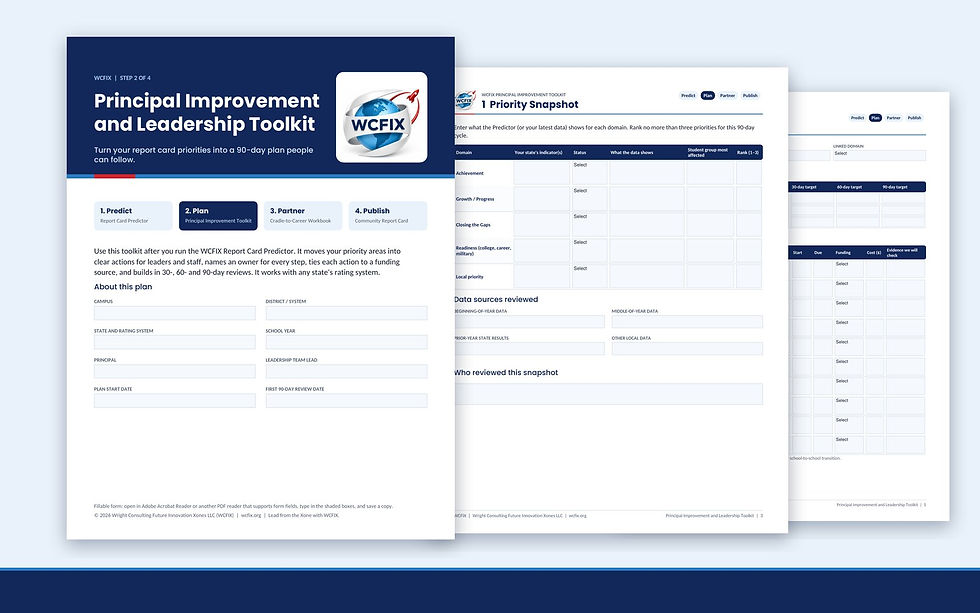
The free WCFIX fillable Implementation and Scoring Guide provides a shared rating scale, a review protocol, a first-30-days reflection rubric and a campus-safety implementation rubric. Leaders can enter evidence, actions, owners and dates, then save their copy.
It is a free beta with no purchase, sign-in or email gate. It does not include the complete paid Principal 90-Day Entry Plan or its later phases and templates.
Do not ask only, “Are we green?” Ask, “What evidence would make green credible?”
References
Fleming, C. M., Calvert, H. G., & Turner, L. (2025). Supporting implementation of universal prevention initiatives in K–12 schools: Impacts on fidelity through organizational readiness and team functioning in a cluster-randomized trial. Implementation Science Communications, 6, Article 4.
Locke, J., Corbin, C. M., Goosey, R., Collins, V. K., Ehrhart, M. G., Hatch, K., Espeland, C., & Lyon, A. R. (2025). Not getting better but not getting worse: A cluster randomized controlled pilot trial of a leadership implementation strategy. Implementation Research and Practice, 6.

Comments