

Your School Is Working Hard. Why Aren’t Results Catching Up?
Updated: 3 days ago
By Dr. Harold L. Wright | WCFIX
The first quarter is over. Your beginning-of-year results were below expectations, and recent student work still raises concerns. Teachers are working hard. Intervention groups are meeting. Your improvement plan is written. Yet something feels out of sync.
You can see the effort. You cannot yet see consistent learning. The pressure to add another program, meeting, or monitoring tool is growing.
Before you add more, bring the essential work into alignment. Choose a few things your evidence says matter, prepare people to do them well, and follow through.
1. Find where schoolwide routines break down
Start with one priority in your campus improvement plan and follow it into the school day. Examine how students enter and begin meaningful work, how teachers prepare lessons, how leaders provide feedback, and how teams respond when students struggle.
Look for consistency across classrooms. Do transitions protect learning time? Do teachers check understanding across the class? Does feedback lead to a specific change? Use repeated observations, student work, and staff perspectives to test your impressions.
In Leading Schools That Work, I urge leaders to examine where RBIS, schoolwide routines, observation and feedback, and PLC practices reach classrooms—and where they remain intentions. The assessment should produce a few evidence-based priorities with owners and review dates (Wright, 2026, Chapter 4).
Your first move: identify one routine whose inconsistency is interfering with the learning priority. Define what effective implementation looks like before asking for more.
2. Make PLC time change the lesson students experience
An effective professional learning community prepares teachers for the learning ahead and helps them respond to the learning that actually occurs.
Begin with lesson internalization. Teachers study the objective and lesson sequence, complete the student task, examine a strong response, anticipate misconceptions, and identify the essential instructional moves. Preserve the purpose and sequence of the adopted materials while planning appropriate supports.
Then rehearse one demanding part. A teacher might model how to select text evidence and explain why it supports a conclusion. Colleagues examine whether the thinking is visible, what students will practice, and how the teacher will check understanding. This is an illustrative application, not a reported classroom study.
Rosenshine’s (2012) research synthesis describes an elementary mathematics experiment in which teachers used eight minutes daily to review prior learning, address errors, and practice essential skills. Students in those classrooms achieved higher scores than comparison students. The useful lesson is the purposeful routine; eight minutes is not a universal prescription.
Explicit models, guided practice, and checks for understanding give the framework concrete expression. My book similarly describes studying the lesson’s objective, rigor, anticipated misconceptions, and expected student actions before observation (Wright, 2026, Chapter 12).
Examine engagement through research-based instructional strategies (RBIS). TEA’s Strong Foundations resources emphasize foundational literacy skills, complex text, knowledge building, and text-based responses, alongside opportunities for productive struggle in mathematics (Texas Education Agency [TEA], n.d.).
Ask what students are thinking about and how they demonstrate understanding. Can they explain their evidence or reasoning? Are language supports and accommodations helping them participate in the intended learning? Appropriate modeling should prepare students to think; support should respond to their readiness and the task.
Your next move: rehearse one lesson segment, teach it, and bring student responses back to the PLC. Identify what students understood, plan an adjustment, and check again. That follow-through connects the meeting to engagement and learning.
3. Check fidelity and learning before rewriting the plan
A scheduled practice is only a starting point. Fidelity asks whether its essential components were delivered as intended. Carroll et al. (2007) describe adherence through content, frequency, duration, and coverage, with factors such as delivery quality and support influencing implementation. Their conceptual framework helps distinguish an implementation problem from a weakness in the approach itself.
For example, a weekly PLC may appear on every calendar while its time is repeatedly consumed by announcements. Before concluding that collaborative planning is ineffective, examine whether lesson study, rehearsal, student-work analysis, and instructional follow-up actually occurred. This example illustrates the framework; it is not a finding from the Carroll study.
BOY results establish a starting point. Combine them with current assessments, student work, attendance, and classroom evidence. Check that measures are comparable before interpreting change. A low score identifies a concern; further evidence is needed to explain it.
Hamilton et al. (2009) recommend an ongoing cycle of evidence use and instructional improvement. Ask: What specific gap persists? What explanations fit the evidence? What will we change, and what evidence would show improvement?
Update one or two priorities in the existing plan. Name the action, owner, support, implementation measure, student-learning measure, and review date. Protect the essential practice, document purposeful adaptations, and adjust when the evidence calls for it.
WCFIX can help you make the next move
If this describes your campus, you have a practical place to begin. WCFIX offers resources and guided support for the diagnosis, planning, and follow-through this moment requires.
Use the WCFIX Campus Practices and Pillar Assessment Toolkit to examine routines, observation and feedback, PLCs, and curriculum implementation. Its workbook and Assessment Administration and Scoring Guide help your team organize evidence and identify priorities.
Use the A–F Campus Action Plan Toolkit to translate those priorities into actions and progress checks. Customized coaching and facilitation can support lesson internalization, explicit instructional models, evidence-based feedback, and productive PLC routines. Leading Schools That Work provides the leadership lessons behind this approach.
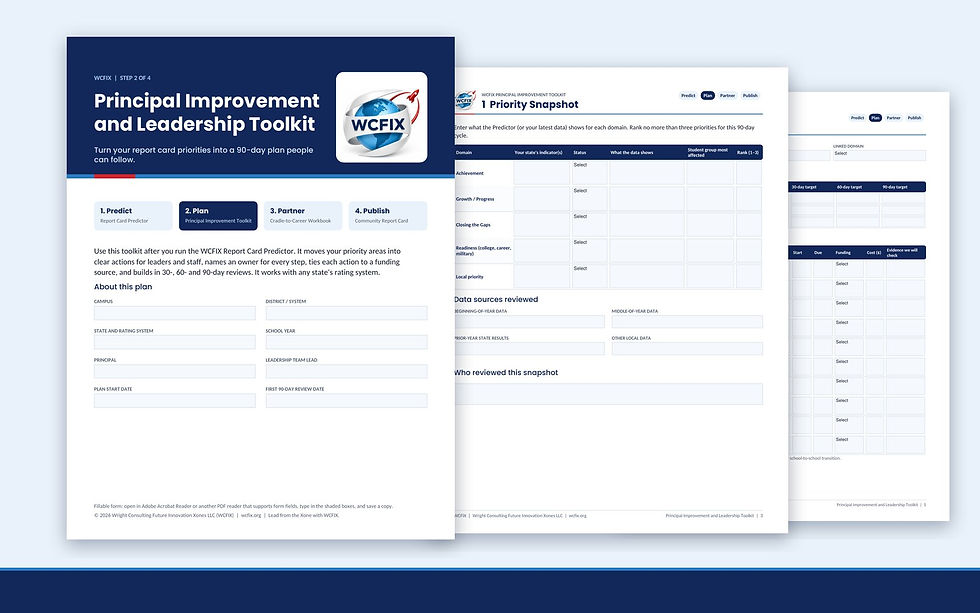
New: Want to know where those priorities will land in your rating? The WCFIX A–F Domain Predictor estimates your Student Achievement, School Progress and Closing the Gaps scores and your overall rating for 2027, using TEA's published method. It shows how many points each area needs to reach the next letter and recommends where to start. A companion guide with a fillable 90-day action plan is included.
Your next quarter needs a clear focus your team can carry through. Start with one priority. Implement it well. Examine the learning. Build from there.
Develop the Leader. Transform the System.
References
Carroll, C., Patterson, M., Wood, S., Booth, A., Rick, J., & Balain, S. (2007). A conceptual framework for implementation fidelity. Implementation Science, 2, Article 40. https://doi.org/10.1186/1748-5908-2-40
Hamilton, L., Halverson, R., Jackson, S. S., Mandinach, E., Supovitz, J. A., & Wayman, J. C. (2009). Using student achievement data to support instructional decision making (NCEE 2009-4067). National Center for Education Evaluation and Regional Assistance, Institute of Education Sciences, U.S. Department of Education. https://ies.ed.gov/ncee/wwc/practiceguide/12
Rosenshine, B. (2012). Principles of instruction: Research-based strategies that all teachers should know. American Educator, 36(1), 12–19, 39. https://www.aft.org/sites/default/files/periodicals/Rosenshine.pdf
Texas Education Agency. (n.d.). Research-based instructional strategies. Strong Foundations. https://sites.google.com/tea.texas.gov/strongfoundations/lea-resources/rbis-research-based-instructional-strategies
Wright, H. L. (2026). Leading schools that work: Practical lessons for principals, superintendents, and district leaders. Wright Consulting Future Innovation Xones LLC.

Comments