

Your PLC Talked About the Lesson. Who Actually Practiced It?
By Dr. Harold L. Wright | November 3, 2026

The PLC ends. Teachers understand the agenda, the materials are ready, and everyone agrees on the lesson. One question remains: Did each teacher practice the part most likely to challenge students?
Lesson discussion helps a team prepare. Rehearsal adds an opportunity to try a specific instructional move, receive feedback, and try again before teaching. For a principal, the next step is to make that practice focused, useful, and connected to classroom evidence.
What the research supports
Darling-Hammond, Hyler, and Gardner’s (2017) review of 35 rigorous studies identified recurring features in effective professional development, including active learning, collaboration, modeling, feedback, and sustained opportunities to learn. These findings suggest a design direction: give teachers meaningful opportunities to practice and refine work connected to their curriculum. The review does not establish that any single rehearsal protocol guarantees improvement.
Kraft, Blazar, and Hogan’s (2018) meta-analysis of 60 studies using causal designs found positive average effects of teacher coaching on instruction and achievement. Much of the evidence concerned early childhood and elementary literacy, and effects were smaller in larger-scale programs. That supports careful implementation and follow-through rather than assuming that one PLC routine will reproduce the research findings.
A current caution matters. The U.S. Government Accountability Office (2026) found mixed evidence about which professional-development elements contribute to stronger student results. It also reported that 67% of teachers in a nationally representative 2022–23 RAND survey said collaborative learning improved their teaching or their students’ learning. Teacher perceptions are useful; they are not causal proof of achievement gains.
Make rehearsal specific enough to help
Consider this illustrative example. A mathematics team is preparing to teach equivalent fractions. Instead of asking teachers to “rehearse the lesson,” select a short explanation using equal-sized wholes and a question that reveals student reasoning.
Each teacher practices in a pair. The observer records whether the explanation connects the model to the equivalent fractions. Feedback names the observed evidence and one revision. The teacher then repeats the segment.
The principal’s questions become concrete: Did each teacher practice? Was feedback specific? Was there another attempt? Did the practiced move appear in the lesson? What did students understand afterward? The team checks both implementation and learning, without treating a completed meeting as proof of either.
Texas’s current Effective Schools Framework connects PLC planning and curriculum internalization with observation, feedback, action tracking, and student-work analysis (Texas Education Agency, n.d.). Rehearsal can be one practical way to connect those activities; it should fit the adopted curriculum and the team’s needs.
Turn the concern into a dated action plan
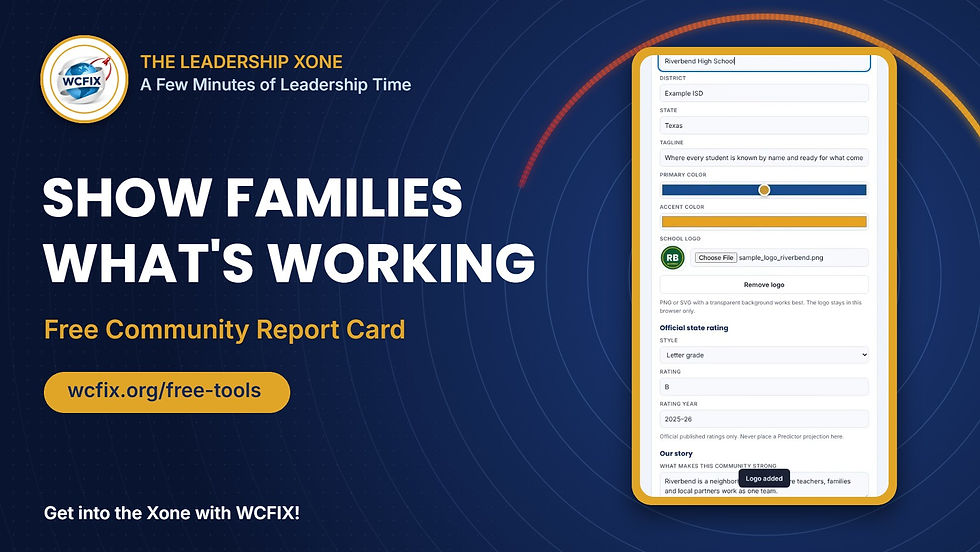
The free WCFIX Leadership Action Mapper helps a team organize a problem, its evidence, possible explanations, and next steps. Enter “Improve lesson rehearsal in our PLCs,” add what you have observed, and revise the suggested branches.
The generated action plan includes an owner, beginning date, progress-monitoring date, completion date, and evidence to review. Suggested dates are editable calendar-day starting points; adjust them to your school schedule. At monitoring, decide whether to keep, adapt, or stop the change.
The tool uses guided templates rather than claiming to diagnose a campus or prove a cause. Our companion guide includes a worked map, rehearsal agenda, feedback dialogue, developmental rubric, and reusable worksheet. The guide’s cases are illustrative; the tool and rubric have not been independently validated.
A future-focused plan also asks whose access needs attention, which student skills the work develops, and what changing needs the school should anticipate. The mapper includes a college, career, and future-readiness starting point for examining pathways, partnerships, and responsible technology use. For every suggested practice, leaders should check the research, local evidence, curriculum fit, and capacity to implement it.
Start with one upcoming lesson segment. Give every teacher a useful practice opportunity. Then return to the evidence together.
For a broader look at routines, feedback, and PLC practices, explore the WCFIX Campus Practices and Pillar Assessment Toolkit, or discuss facilitated support for your leadership team. The mapper and companion guide are free; the assessment and facilitation are separate offerings.
References
Darling-Hammond, L., Hyler, M. E., & Gardner, M. (2017). Effective teacher professional development. Learning Policy Institute. https://learningpolicyinstitute.org/product/effective-teacher-professional-development-report
Kraft, M. A., Blazar, D., & Hogan, D. (2018). The effect of teacher coaching on instruction and achievement: A meta-analysis of the causal evidence. Review of Educational Research, 88(4), 547–588. https://doi.org/10.3102/0034654318759268
Texas Education Agency. (n.d.). Lever 5: Instructional leadership and capacity building. Effective Schools Framework. Retrieved November 3, 2026, from https://texasesf.org/lever-5/
U.S. Government Accountability Office. (2026, March 27). K–12 education: Research on effectiveness of professional development is mixed, but teachers find collaborative learning most useful (GAO-26-107874). https://www.gao.gov/products/gao-26-107874

Comments